
4-6 April 2011
Partner Church : Tokyo Bible Church, 3-40-4-2F Matsushima, Edogawa-ku, Tokyo 132-00311 Japan
Senior Pastor: Ps Makoto Fukuda
Ps Makoto is an extremely humble man, speaks Excellent English, graduated in a Goldcoast Australian Bible College, his father is 76 years old this month and has planted 18 churches in Japan. His father also planted the Tokyo Bible Church, probably his last one, and passed to his son, Makoto, to pastor. The Church also runs a Christian school, bible school, a government registered NPO . This church is well connected with international churches in Taiwan, Hong Kong and South Korea.
 On the day of the earthquake and Tsunami hit, Ps Makoto received so many emails and calls from friends all over the world, asking what he was going to do about it, he prayed and seek God’s face and was led to help Ishinomaki and Onagawa in North Sendai area to serve the needy people; both places suffered greatly in the shake and Tsunami, both Ishinomaki and Onagawa seaside town’s houses almost got totally wiped out and flattened. He immediately called a church in Ishinomaki, to find out if Ps Ito, his family and his church was alright. The church was damaged slightly, with water up to 2.5M high came in, everything got wet, thank God not one church member was lost.
Ishinomaki Christian Church became the base for Tokyo Bible Church to reach out to the needy. Despite the damage within the church and their members’ houses suffered too, many came forward and wanted to participate this compassion ministry and offered help.
4th April 2011
 We made an overnight stop over in the city centre of Sendai, outwardly everything looked peaceful and quiet, looked closely, you would find many shops were closed, even after 3 weeks, one could tell where water had been, cracks could be found on walls, streets, many shattered windows, now covered by a plastic sheet. Many planned activities were postponed indefinitely. The Japanese braved this disastrous adversity well, we visited one tea shop Centre called Shalom, working with Tokyo Bible Church, they opened up the tea shop, invited those have needs to come in to sit and share a moment with them, to have a cup of tea, to talk about their trauma.
 We spent our night in a local inn, the atmosphere was very tensed, this place always shake, to the Japanese it was norm, to us, I packed and slept in such manner, I would be ready to run! It was kind of like carrying a knife round your neck, you don’t know when it would fall.
5th April 2011

Next morning, we continued the journey to Ishinomaki, as we got closer, we saw rubbish of all sizes and all kinds were everywhere. Cars were blown into paddy fields, square structures that might have been houses before, some houses only left with iron rods, boats got landed on shore in the middle of the road, bars along bridges were bended and twisted, it was hard to describe the enormous devastation in front of our eyes, yet in its best Japanese tradition, they tidied up their rubbish and lined them up nicely, waiting to be picked up by cleaning trucks, and it was no small task, every imaginable household items could be seen, piles of floor tatami, fridges, washers, cookers, clothes, sofa, all that have gone through the salty water, not a lot could be saved, shops and homes alike.

A team of 15 including pastors came from Tokyo Bible School, they came to help to clean up Ishinomaki Christian Church, so that it could be re-opened, for the neighbor to come into the church to take needed food or resources. To take a rest, and to hear the Good News. It is also the temporary base for TBS to store their materials, from this base, they could reach out to the people in North Sendai.
We met with Pastor Hirai, who shared with us what happened on the day of the earthquake and Tsunami. Later Ps Makoto asked him if he could find some storage space in the city as an office and warehouse to use. Few hours later, Ps Hirai called back, and said to follow him. It turned out he has a parking lot, and since the devastation, no car parked there, and he would give half of the parking lot to TBS to use free. We praise God for this small miracle. With a base, Ps Makoto could do some long term planning to benefit and help the people in Sendai. As we moved around town, we saw some food companies sent out trucks to cook noodles for those with needs, and the line was very long. The hungry need is very real. Not one shop was opened, nothing was available for these folks. Even you have money one could not buy a thing.

Later we met and talked with Pastor Ito, the senior pastor of Ishinomaki Christian Church, he urged Christians all over the world don’t forget Japan, please pray for Japan, please help Japan. Then Ps Sawa of this church denomination in Tokyo made a plea to Christians to pray for hope, many left with no hope, many need Jesus, as he led us to pray, we all felt his heart of desperation and pain for his countrymen.
We went up to the top of a mountain, which must have been a scenic spot once, we took a look at the coastal city, what city? There was nothing there, just rubbles, broken houses, empty lots; Ps Makoto said the first time he came, he was speechless, he saw what happened to the town and he could just cry, what happened to the people, what happened to all these houses. The first time he came here, he saw bodies floating.
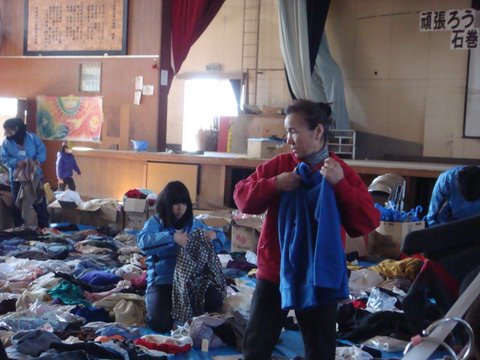
We then went to what was a primary school, now became a shelter center, the school was slightly damaged but was safe to have refugees there – the centre took in 400 people, each could have a space about the size of a single person floor bedding. Having escaped with nothing but only what they wore, they entirely depended on government and the generous donation from people, from as simple as a piece of soap to clothing, shoes, bedding etc.
Evening temperature in North Sendai was around zero degree C without heater in the classrooms. The school auditorium became a resource centre, kitchen, announcements posting place. Volunteers like TBS came to cook for the 400 people. The refugees only got two meals a day, breakfast and dinner. Many groups took turn to cook, refugee residents would drift in to see what’s on the menu, would go around the room, to search out what they need, any new clothing arrived that could suit them or fit them.

On the first floor, big poster of names was posted, for those come in to look for survived relatives or friends. Sometimes, a relative found a missing relative, the reunion was a bit of a sweet sorrow. Medical team would come and would pay visits to make sure the old and sick are alright. Sometimes entertainers would come in to sign songs to encourage the residents. The afternoon we were there, a famous Christian TV singer came. Herself lost her parents in the last Kobe Earthquake, so she knew the pain and sorrow, she came to encourage the residents.
Typical Japanese fashion, to enter the shelter building, one still have to take off shoes, wore slippers ! One floor would be for children, one floor for sick people etc.
We got the only two rooms in the city that night in a hostel, despite this is the place where major earthquake took place 3 weeks ago, tonight I felt safe. With 7 of the TBS volunteers all cramped into my room, to borrow the shower, tonight we would be fine, tonight we stayed together to share about God’s goodness.
6 April 2011

We went back early in the morning to cook breakfast for the residents in the School, people drifted in to look at the red bean soup with mochi inside, so yum yum, they would grab a chair and sat down, waiting for the rice to be cooked and made into tuna onigiri (tuna rice ball). Our team was serving them, inviting them to sit down, or helped carry their food to their rooms. They went “shopping”, looking through new piles of clothing that came in yesterday or this morning, to see what would fit them. Behind us, another team was preparing curry rice, children hovered around us, wanting to help, afterall school was impossible, all the kids were “on holiday”. Today the news said Tokyo Electric Company would compensate 1000 Yen (US$12) per family, in serious protest, they changed the words to say this is a temporary compensation and Government promised to compensate 1M Yen to those that lost their house or farmland. The rebuilding would be a long way to go. Stories began saying many survivors began to kill themselves, they felt no hope, the owe banks lots of money to do their farming or fishing business. Trauma counseling must take top priority too.

After the clean up, and we took another look at the car that got blown into the school swimming pool, it was an odd sight, with the Defense Army standing by, being helpful. We moved our food truck to Onagawa, another very hard hit place, almost 90% + wipe out. The two shelter homes we drove past were of Government run, the residents would have sufficient supply. North of Sendai is a very hilly place, many smaller, not so easy reached villages. (CRASH is working on South of Sendai, which is flat land), TBS decided to help these people, the local term calls them Home Refugees, their houses were not damaged bad enough for them to leave, but it was enough that they did not have electricity, water. This village we entered in, as soon as the cars stopped, we could smell the fishy rubbish smell, they were said not to clean up but wait for government. But their village got no one died, government would not think it serious to help, yet these people have no food, no clean water, some houses were seriously damaged, no toilet facilities, no hot water to bath, no cooking facilities. TBS stopped the vehicles, calling families to come and to take what they need, it was like a mobile mini-supermarket, but alas, two babies need pampers, we forgot to bring; we also forgot to bring baby formula. One lady said her baby had no clean pampers, no clean water to bath or wash the bottom of the baby, she was so afraid the baby might get rash. One family managed to borrow a generator, but no fuel, what to do, so they used the generator carefully, and let the other families taped into the electric generator as well.

Our team began cooking for the villagers too, when they heard a food truck came, they began coming out of their homes and was happy to have visitors and food. They had not eaten any fresh vegetable or fruits for a long time, no one would take any produces from Fukushima area. They asked if we could bring them fresh vegetable the next time. TBS became their life line, became visitors in their dark nights, to bring comfort and hope. These Home Refugee received no help from the Government.
One 84 years old lady was telling us, they used to live by the river below this village, when the Tsunami hit, her husband told them to keep running to the mountains, they must not run along the river, and they listened to him and ran for their lives towards the mountain. Now they all came and stayed with their daughter.
Onagawa, received the full blown of the Tsunami, the water was as high as 20M, along the coastal town, not one house could withstand the full force of the hit, cars were everywhere like broken abandoned toys. Houses collapsed, out of shape, Farmland, fish farm, many trees were totally destroyed.
I was not sure if I was looking at a war-torn zone or a Toledo hit area.
We must continue to help Japan. Not because it is in Asia I say that, because this country needs Jesus, we missed the opportunity to evangelize in 1948, in 2011 God gives us another chance, dare we do less?
The total population in Japan is 127,076,183 making it the world's tenth most populated country in the world. People estimated there are 0.5% Christian population, but reality is probably 0.1%.


